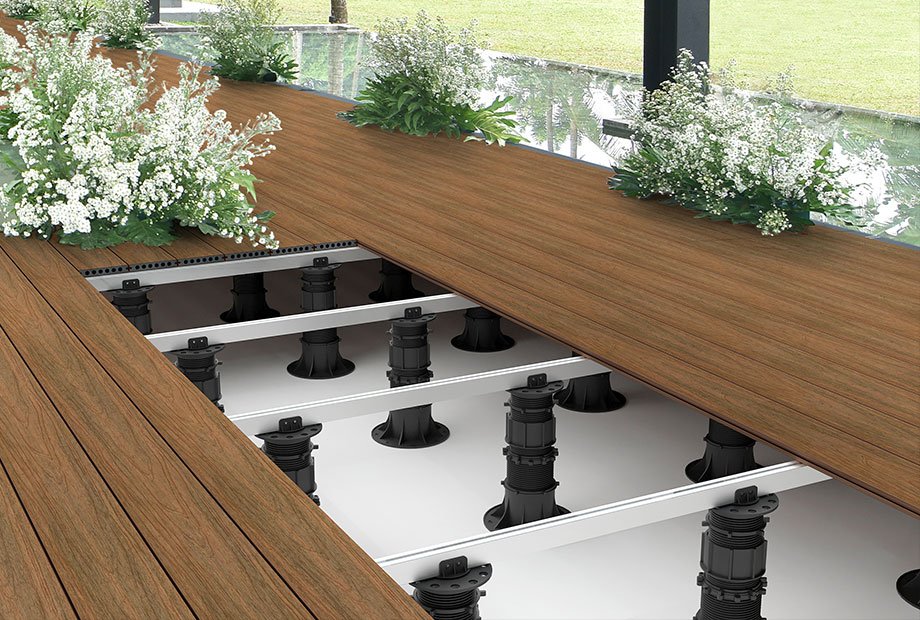
The Hudson Valley’s residential market loves a quiet roof terrace: river views in Nyack, ridgelines in Rhinebeck, and commuter-adjacent rooftops in White Plains. Composite decking promises low maintenance through humid summers and salted air near I-95 corridors. When that decking sits on aluminum or wood joists borne by a roof deck pedestal field, the assembly must respect thermal movement, joist span limits, and the roof’s structural slope.
A roof deck pedestal system for joists is not the same product family as paver tabs, though brands sometimes share bases. The specifier needs to confirm that the selected head accepts joist clips or bearers without eccentric loading. Eccentric loads tip pedestals, telegraphing waves into the deck plane. Manufacturers publish maximum spans; treat those as law unless the engineer provides an alternate path.
Slope and the “level deck” illusion
Roofs are sloped for drainage; decks want to feel flat. Pedestals reconcile the difference with fine height adjustment. In New York State, where ice can sit at perimeters, avoid creating low dams at rail posts or at door saddles. Detail transitions so meltwater can still reach drains even when snow piles against a guardrail base.
Expansion joints that respect composite behavior
Composites expand and contract more than many owners realize. A roof deck pedestal layout should coordinate board runs with manufacturer-required gapping at board ends and at abutments. If the deck runs continuously into a vertical wall without a planned joint, boards can push, buckle clip tracks, or pop screws. Show those joints on plans, not only in a generic note.
Fire performance and exterior rating requirements vary by occupancy and height. Your AHJ in a given Hudson Valley municipality may ask for documentation that matches NYC-style rigor even when the building is shorter. Bring submittals early so product substitutions do not arrive mid-June when furniture is already on order.
We coordinate roof deck pedestal system counts with joist modules for Hudson Valley projects, including second-home roofs where access is seasonal and staging must happen in narrow windows. Send joist depth, target finish elevation, and membrane stack; we will return a height-range schedule that installers can follow without guesswork.